Showing posts with label time frame. Show all posts

Thursday, March 14, 2013

Still Risk On

Risky assets have been on the move lately.  This can be seen in multiple asset classes.  The first sign that we are in a Risk On environment is the widening of spreads on US Treasury Debt versus other governments' debt.  US Treasuries are considered by many the ultimate safe haven and so tend to enjoy a premium when investors are worried.  The premium shrinks or disappears when the worries go away.  

Source: Wall Street Journal
The second sign is the S&P 500 Index's relentless move towards new highs.  The last high was 1,565 in 2007.  We are less than one percent away.


Source: StockCharts.com
With earning's growth expected to be minimal, this has brought up Price Earnings ratio, but not to exorbitant levels. 

Source: Dr. Ed's Blog

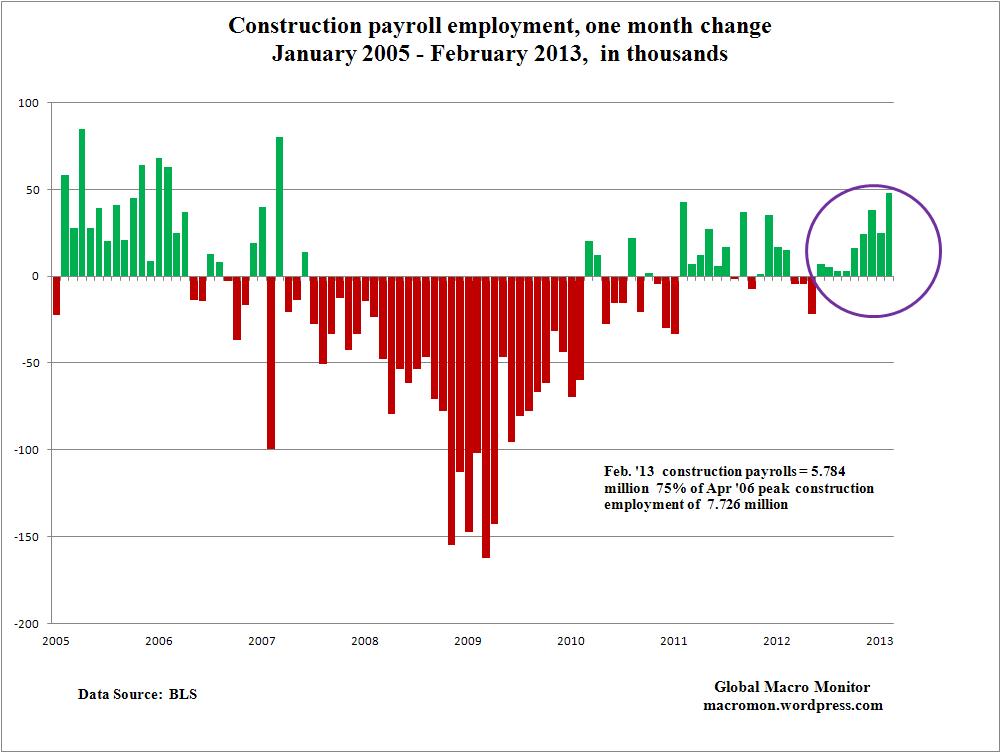
On the economic front, while the 'fiscal cliff' and 'sequester' would appear to have taken away much of our margin for error on the growth front, there are positive signs coming from the private sector.  Construction employment, which tends to pay well, is coming back, along with the housing market.  And both would appear to be still early in the game.


On a more global and esoteric note, South Korean exports, which tend to be a leading indicator of global exports, are growing.  This is despite the increased geopolitical tensions on the Korean Peninsula.  North Korea recently cancelled the Korean War ceasefire and cut off the hotline to South Korea.

Source: Humble Student of the Markets


Other signs of healing include Ireland's first successful ten year debt auction since 2010, Spanish and Italian ten year yields both nicely under 5%, and yields on 'junk' bonds hitting a record low of 5.56%.  Overall, investors seem to be taking a positive view of things.  With things relatively calm on the investment front, I would urge you to make sure you know what your goals are for your investments, what the time frames for those goals are and have a plan in place and know what you will do given different scenarios.  It is much easier and better to do this without the influence of sharp emotions and media hype.

In Japan meanwhile, the Nikkei continues to move up.

Source:StockCharts.com

With the Yen moving down at the same time, the currency affect needs to be hedged out.  While it does not track the Nikkei, the Wisdom Tree Japan Hedged Equity Fund (DXJ)* does hedge out the currency risk and has been a good way to play this rise. 
 
Source: StockCharts.com

While DXJ has moved up significantly since the middle of November, the valuations are just reaching the average for the last five years:

Source:ETF Research Center


Source:ETF Research Center
 
While the speed and size of the move would indicate caution, the valuations would indicate, that there is still more room to go before we get into overvalued territory.  That DXJ has increased  almost 40% in approximately 4 months and has only now reached its average valuations for the last five years, gives an indication of how far sold it was.  Currently, allof this has been based on the election results, statements, intentions and the nominee for Bank of Japan Governor.  We have not seen much hard action.  The situation needs to be watched carefully for continued follow through and success on the part of the Japanese authorities and economy.


*Disclosure: I own DXJ and some vertical call spreads on DXJ in my accounts.

Wednesday, March 13, 2013

What's Your Investment Time Frame?

Two good posts on investment time frames in the last two days.  Barry Ritholtz of The Big Picture started it off with "Why Time Frames Matter to You" and Roger Nusbaum of Random Roger expanded on it with "Time (Frame) Management".  In my opinion, the key points to take away are:  decide what the right time frame is for you, concentrate on what affects your investments over that time frame and pay attention to them. 
 
It is very easy in today's age of instant messaging, 24/7 media and twitter to get caught up in the idea that every little piece of information matters.  Not necessarily.  If you are a short term trader it may matter, while if you are a long term investor it probably doesn't, unless it is a big change or is the confirmation of a change to your underlying reason to buy.  What this constant barrage of data does do is give an advantage to the long term investor that can sift through the noise and take what opportunities the market gives them.  Individual stocks, sectors, or asset classes knocked down based on a single unconfirmed data point, can give you a nice entry point, provided you have done your homework and are paying attention.  Or if you don't have time to pay that close attention, then it can provide a nice entry point for your advisor

Monday, January 28, 2013

S&P Nears All Time High. What's The Plan?

The markets have been on quite the tear recently.  The S&P 500 Index finished above 1,500 on Friday and is within 5% of its all time high.  Good news abounds and investors seem very optimistic(see Is the Whole World Bullish?).  So what does this mean for your portfolio?  Is it time to dive in with both feet?  Or is it time to take some funds off the table? 
 
There are two opposing possibilities at play here.  The bullish case is that we are only in the early stages of a long run bull market in stocks and is supported by two main pillars.  The first is that the 'Great Rotation', the shift back into equities by the retail investor, has begun.  The big inflows into equity mutual funds and ETF's this January after years of outflows are brought out as evidence of this.  The second pillar is that the secular bear market, that started in 2000 is over.  A good summary of this case was tweeted in early January by noted technician Ralph Acampora,  who continues to be bullish. 
 
The bearish case has multiple pillars.    The Shiller 10 year adjusted P/E is still over 20, Europe's structural problems continue,  the US faces increased regulation and legislative gridlock, Japan is initiating a new currency war, the UK is on the verge of a triple dip recession and S&P 500 earnings, while better than expected are barely growing.  At the same time everyone is getting optimistic, so it must be time for a correction.
 
So what to do?  Remember, it all comes back to you and what works for you and what your goals are.  As in most cases, it is better to have a plan in place in case of emergency than to have to think one up as the world falls apart. The same is true of investments.  If you don't have a plan in place, make sure your advisor does.  And make sure you are both on the same page about it.  If not, get a plan in place. 
 
First I would check to make sure that your portfolio's overall asset allocation is in line with your planned targets.  If not, rebalance back to them.  The next step is where looking at investments through multiple time frames comes in handy.  So as not to miss the potential for a long term advance, I would leave long term core positions in place. This is because while long term stock P/E's are expensive, as the old Wall Street saying goes "Markets can stay irrational longer than you can stay solvent."  Alan Greenspan's 'Irrational Exuberance" speech was in 1996.  The markets continued to go up until 2000.  And you don't want to miss that type of ride.  Also, what if the bulls are right and we are in the beginnings of a secular bull market?  The last one went from 1982 to 2000.  And you definitely don't want to miss that ride. 
 
But what if the bears are right?  For that scenario, any short term, trading, or tactical positions should be reviewed and possibly have their risk management parameters adjusted.  In addition, I would be very careful about initiating new positions at this point.  Particularly any marginal ones.  A 5-10% stock market correction could offer a better entry point.  That does not mean don't buy anything at all, it just means you should be more selective and only initiate positions in those investments with truly compelling reward-to-risk ratios.  Anything close to a previously researched upside exit point, would be on a very, very short leash, so as to preserve the gains.   
 
By having a plan and looking at the markets through multiple time frames, it is much easier to block out alot of the constant noise from the street and achieve your financial goals.  What's your plan?